Facing the dilemma of choosing between coworking spaces and traditional offices? Whether located in a modern tech park or in the city’s prime area, the type of office space you choose is significant to your business’s accessibility, growth potential, and brand perception.
The coworking space vs traditional office debate is a necessary one, especially for small and medium businesses, because it impacts your operations, finances, and company culture.
Our article helps you decide between the two working spaces based on key decision-making factors such as overhead expenses and scalability. At the end of the day, what matters most is if your workspace enhances creativity, collaboration, and employee well-being while evolving with your growth trajectory.
Let’s begin by decoding the financial implications of each option.
Traditional vs Coworking Spaces: What Works Financially?
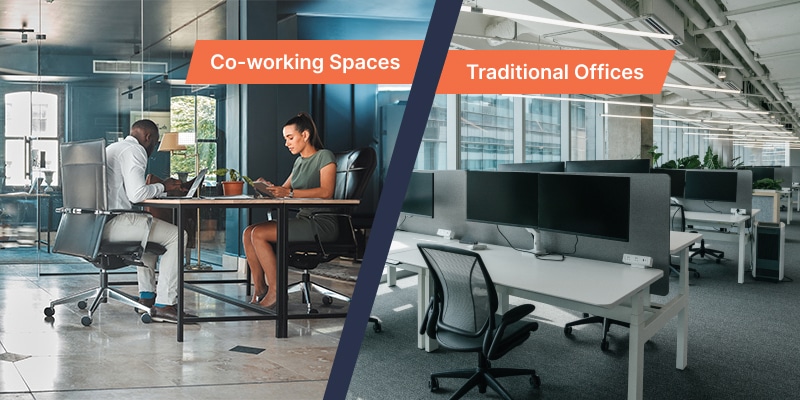
Before delving into the details, let’s first answer the question: What is a traditional office? A traditional office is a business space that requires significant upfront capital expenses to cover the deposit amount, rent, IT peripherals, furniture, maintenance, office supplies, and other miscellaneous costs. Traditional spaces offer privacy and an unparalleled control over the brand experience.
A coworking space, on the other hand, is a shared work environment with multiple businesses harnessing the convenience of a dynamic, creative setting. Unlike traditional offices, coworking spaces:
- Need little upfront investment.
- Provide flexible pricing.
- Are ready for use right away.
Is a Coworking Space Cheaper Than a Traditional Office?
Definitely yes. Compared to traditional offices, coworking spaces are more budget-friendly, thanks to predictable monthly payments that include several amenities. Since they are fully furnished and well-equipped with necessary amenities, you can skip the cost of furniture and utilities. Furthermore, your monthly membership bundles amenities like Wi-Fi, coffee, and reception services into one predictable fee; you’ll love this convenience.
Adopting this cost-effective model enhances financial predictability, protecting burn rates for startups and improving SMB profitability by supporting budget and economic stability. Additionally, coworking eliminates hidden administrative costs for supplier management and maintenance; you’ll appreciate the simplicity of this managed office.
Consequently, flexible memberships allow month-to-month or adaptable plans, safeguarding cash flow while offering scaling freedom. Beyond these financial benefits, the operational flexibility of both models profoundly impacts adaptability.
Matching Workspace Agility to Your Business Growth Plan
When evaluating coworking spaces vs traditional offices, coworking spaces provide short-term leases. This way, you gain flexibility and adaptability, and achieve scalability that can adjust for your team size and growth plans. As a startup facing unpredictable growth, you require this flexibility and adaptability because it lets you modify your workspace footprint without long-term lease constraints, thereby supporting your scalability requirements.
Conversely, traditional offices involve long-term leases wherein commitments typically span years, which constrain your flexibility and adaptability. These long-term leases lock you in. Hence, adapting quickly proves harder, potentially wasting resources instead of enabling growth and hindering your growth plans.
Achieving scalability with traditional offices demands relocation or renegotiation of long-term leases, because fixed commitments limit adjustments, which becomes costly and time-consuming.
Therefore, for businesses seeking balance, the hybrid office model offers core-team stability while utilising coworking for project-based flexibility and adaptability, thereby supporting your growth plans and scalability needs. Beyond operational flexibility, your workspace choice profoundly shapes company culture and brand identity.
Also Read: Why Coworking Spaces for Remote Teams Are a Strategic Growth Investment
How Your Workspace Highlights Your Brand and Company Culture
Let’s first explore how traditional offices contribute to your brand and shape your company culture.
This workspace provides a stable and private environment that helps you show a strong brand identity and maintain operational privacy. This control helps your team work better together and shape how clients see your business — allowing you to create spaces that reflect your company culture.
Conversely, for startups in the fast-paced technology industry, coworking spaces create an energetic, collaborative community through the aggregation of diverse professionals, generating valuable networking and collaboration opportunities, which create innovation and help in luring the best talent. Now, let’s come to a general query:
What are the main advantages of a coworking space? The principal benefits of a coworking space are:
- Cost-Effectiveness: Low up-front investment, tiered pricing, and grouped amenities into a fixed monthly fee.
- Financial Predictability: Protects burn rates for startups and enhances SMB profitability.
- Operational Simplicity: Removes hidden administrative expenses of supplier management and upkeep.
- Flexibility and Adaptability: Leases for short terms enable easy reconfiguration of team size and workspace footprint to accommodate volatile growth.
- Scalability: Enables fast scaling up or down without long-term lease restrictions.
- Networking and collaboration possibilities: Promotes a dynamic, collaborative environment by uniting diverse professionals, stimulating creativity, and attracting top talent.
- Ready Accessibility: Enables companies to begin operations immediately without lengthy setup.
Then again, shared facilities within coworking spaces generally pose their share of challenges too — such as a compromised sense of privacy and possible noise and distractions that would be a hindrance to concentration.
Additionally, possibilities for customisation in shared spaces are still limited — a far cry from traditional offices’ branding flexibility. While comprehending these varying effects on culture and brand is essential, the final call depends on further assessment of your specific business requirements.
A Practical Guide to Making the Right Choice
To help your business succeed, making the right choice between Coworking Spaces and Traditional Offices requires a carefully thought-out self-evaluation with the key factors evaluated and aligned with your strategy.
Take into consideration these important decision-making factors:
- Team Size: Assess your team size. By having a small team, you can take advantage of coworking’s flexibility, whereas a larger team typically requires the dependability of a traditional office; this factor plays a massive role for startups and entrepreneurs in SMBs.
- Budget: Coworking spaces offer cost-effective solutions and avoid high upfront capital expenditure, whereas traditional offices demand significant investment; therefore, for your business to maintain budget and financial stability, especially as a startup, coworking proves financially prudent.
- Nature of Work: Evaluate the nature of your work. For tasks needing confidentiality or advanced configurations, traditional offices are better, whereas coworking suits collaborative environments; this consideration is essential for company culture and brand positioning.
- Growth Plans: Your growth plans and scalability needs, and contract flexibility requirements play a massive role: coworking provides adaptability for rapid scaling, whereas traditional offices offer stability but less flexibility for your business to evolve efficiently. Coworking often supports agile development.
- Location: Location is crucial. Coworking spaces situated in business districts enhance convenience, client perception, and professional image. For accessibility and networking, this factor warrants careful evaluation.
By methodically evaluating these interconnected factors discussed, you move beyond basic comparisons to select a workspace that aligns with your Stage of Business Growth and Company Culture and Brand Positioning — setting the stage for future success.
Your Workspace is More Than Rent: It is a Strategic Tool
The choice between coworking spaces and traditional office space is a strategic asset requiring alignment with your financial constraints, growth trajectory, and company culture.
To make an informed decision, consider cost-effectiveness, flexibility, and team cohesion. Ultimately, the optimal solution isn’t universal but tailored to directly support profitability and foster continuous growth.
As the future of work evolves, flexible models like workspace as a service become instrumental. They enhance adaptability for thriving businesses, attract skilled workers, and ensure your company’s long-term success.
Tirunelveli’s Tiliconveli is one such hub serving as a key destination for upcoming enterprises in South Tamil Nadu. Want to know more about our coworking space? Connect with us today.